

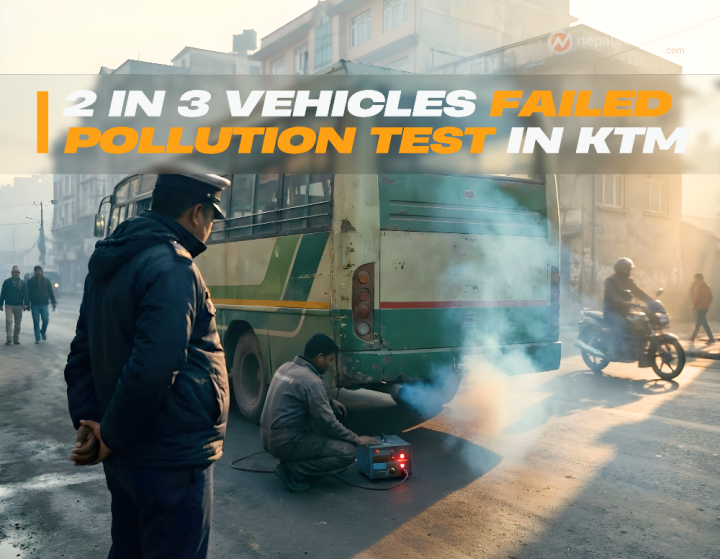
Nearly two out of three vehicles tested in Kathmandu fail emission standards
Diesel vehicles dominate the failure list, emitting excessive black smoke
Traffic police and Kathmandu Metropolitan City have begun roadside enforcement
Fines and possible restrictions are now on the table for repeat offenders
Poor maintenance and aging vehicles are the core culprits
Kathmandu’s latest vehicle pollution checks have delivered a blunt message. Our roads are far dirtier than most drivers believe. Official inspections show that around 67 percent of vehicles tested failed to meet emission limits, releasing smoke and gases far above permitted levels.
This is not a marginal issue. It is systemic. From crowded city junctions to busy ring road stretches, non compliant vehicles are a daily presence and a major contributor to the valley’s worsening air quality.
The worst offenders are diesel powered vehicles. Buses, trucks, pickups, microbuses and older SUVs dominate the failure statistics.
In multiple roadside checks, a clear majority of diesel vehicles failed instantly, many producing thick black smoke visible even without testing equipment. Petrol vehicles fared better overall, but a noticeable portion still failed due to poor tuning and neglected maintenance.
The message is simple. Fuel type matters, but maintenance matters more.
Authorities have focused on high traffic and high exposure zones, including major intersections and arterial roads. These areas see heavy congestion, long idling times and dense pedestrian movement.
By targeting these locations, enforcement teams are testing vehicles where pollution impact is felt most sharply by the public.
Two reasons keep repeating.
First, aging vehicles. Many diesel vehicles on Kathmandu roads are far past their prime, running on outdated engines with worn components.
Second, poor maintenance culture. Delayed servicing, ignored engine warning signs and faulty exhaust systems are common. Small fixes left unattended turn into guaranteed test failures.
This is less about bad luck and more about neglect.
Vehicle emissions are a major source of fine particulate matter in Kathmandu. These pollutants penetrate deep into the lungs and bloodstream.
The consequences are already visible. Rising respiratory issues, aggravated asthma, chronic cough and increased cardiovascular risk are becoming everyday realities for city residents, especially children and the elderly.
Dirty vehicles are not just a mechanical problem. They are a public health threat.
The initial phase focused on awareness. Drivers were advised to service vehicles and reduce emissions voluntarily.
That phase is ending.
Kathmandu Metropolitan City and traffic police have now started issuing fines to vehicles that fail pollution tests, with stricter actions planned for repeat offenders. Discussions are underway about restricting heavily polluting vehicles from busy routes altogether.
The tone has changed. Compliance is no longer optional.
Passing a pollution test is not complicated if basics are handled properly.
Regular servicing, proper engine tuning, functional exhaust systems and timely replacement of worn parts make a measurable difference. For diesel owners especially, ignoring smoke issues is no longer viable.
Cleaner vehicles run better, cost less over time and keep drivers out of trouble.
A city cannot talk about clean air while allowing most of its vehicles to fail basic emission checks. The 67 percent failure rate is not just a statistic. It is a signal.
If enforcement stays consistent and owners take responsibility, this number can drop. If not, Kathmandu’s air will keep getting heavier, darker and harder to breathe.
The test results are in. What happens next depends on how seriously we take them.
PREVIOUS NEWS

Nepal Auto-Trader is one-stop platform for all automotive needs. We provide unbiased and unparalleled news/reviews of all auto-motives being launched in Nepalese Auto-Industry. Find recent updates and price of bikes/cars, compare and review recently launched bikes/cars, buy/sell/trade reconditioned cars/bikes and all government news about changing rules and regulation, road safety by subscribing us.

Subscribe to our Newsletter
© Copyright 2026, Nepal Autotrader


.png)
.png)