

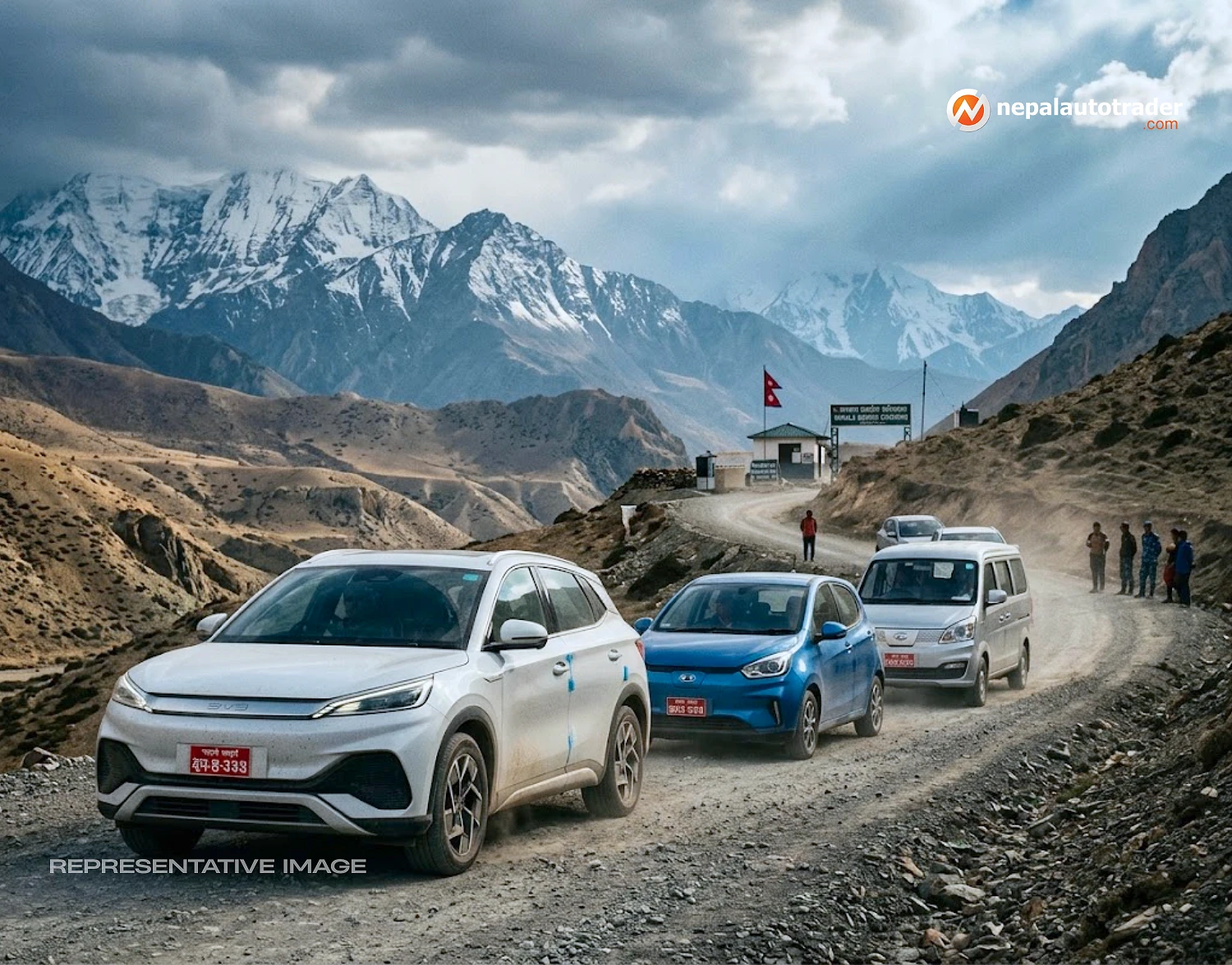
Nepal's electric vehicle supply chain is taking a decidedly different route this year. With the country's established China-facing checkpoints unavailable, automobile importers have turned toward Korala in Mustang, and the flow is no longer limited to a few trial shipments.
According to the Mustang Customs Office, 133 EVs arrived through Korala during Bhadra, and the vehicles were undergoing customs clearance when the latest report was published. Another 100 EVs had entered through the same route in Shrawan. The customs office also said additional vehicles were on the road, although their exact number was not yet known.
That makes Korala more than an emergency detour. For Chinese EV distributors, it is increasingly becoming the practical answer to a very immediate problem: how to get booked cars into Nepal when the usual routes are not available.
The shift is rooted in disruption at Nepal's traditional China trade gateways. Rasuwagadhi and Tatopani remained closed, leaving importers who source vehicles from China with limited options for moving inventory into the country.
The timing could hardly be worse for distributors. Automobile businesses took substantial bookings during the NAIMA Mobility Expo and NADA Auto Show, with many vehicles expected to reach customers around the Dashain and Tihar festive period.
Those commitments do not disappear because a border closes.
Importers have therefore started diverting vehicles for which letters of credit had originally been opened for Rasuwagadhi or Tatopani. New import orders are also being arranged with Korala designated as the customs point.
The significance extends beyond EVs. But electric cars are particularly visible because Chinese brands have become such an important part of Nepal's recent automotive growth.
| Period | EVs through Korala | Status |
|---|---|---|
| Shrawan | 100 units | Imported through Korala |
| Bhadra | 133 units | Arrived and undergoing customs clearance |
| Additional shipments | Exact number not known | Reportedly on the way |
The latest monthly figure is notable because these are not vehicles merely being discussed or ordered. They have physically reached the customs process at the Nepali side of the border.
Mustang Customs Chief Bidur Chudal said additional staff had been deployed to make customs clearance easier as the number of vehicles increased. That response matters. A border route is only useful to an automotive distributor if customs can process vehicles at something close to the pace at which they arrive.
For buyers waiting on cars, this is the less glamorous part of the story, but arguably the most important one. A vehicle sitting in a customs yard is still a vehicle that cannot be delivered.
The Korala route is already carrying a broad mix of Chinese electric vehicles rather than serving a single manufacturer. The brands identified include:
That variety is important. It suggests the route is becoming part of the wider distribution network for Chinese automobiles entering Nepal, not simply a temporary channel for one or two distributors.
The development also arrives as competition inside Nepal's EV market continues to intensify. Models such as the BYD Atto 2 have rapidly built market momentum, while newer and more aggressively priced products are competing for buyers across several segments.
For Nepal's automobile industry, the calendar matters almost as much as the border.
Dashain and Tihar are major vehicle-buying periods, and distributors had already taken bookings during the year's two major auto exhibitions. The original plan was straightforward: bring vehicles into Nepal and hand them over to customers around the festive season.
The border disruption has complicated that plan.
Korala gives importers a way to keep deliveries moving, even if the alternative route creates logistical challenges. The source report does not provide an exact additional transport cost or delivery time for these EV shipments, so there is no basis for assigning a precise financial penalty to the detour. What is clear is that importers are willing to use it because waiting for the conventional routes is not an attractive option.
This is where the story becomes bigger than 133 cars. Supply-chain flexibility is becoming a competitive advantage in Nepal's EV market.
This is not the first time Korala has carried a meaningful volume of electric vehicles. After flooding and landslides disrupted Tatopani and Rasuwagadhi last year, the government brought the Mustang customs operation into regular service from Bhadra 31, 2082.
According to the latest report, approximately 3,000 EVs were imported through Korala last year, while the customs office collected Rs 6 arba 92 crore in revenue during that period.
That previous experience gives today's importers something valuable: proof that the route can support automotive trade at scale.
It also changes how the industry may view Korala. A route that once looked like an emergency backup can become a useful secondary corridor, particularly when Nepal's dependence on a small number of China-facing checkpoints creates a single-point vulnerability.
The immediate priority is obvious, keep booked vehicles moving.
But the longer-term question is whether Korala remains heavily used once the conventional border points return to normal operation. The current report does not provide a reopening timetable for Rasuwagadhi or Tatopani, so any prediction about when import patterns will normalize would be premature.
For now, the industry has adapted quickly. Importers are changing logistics arrangements, customs authorities are adding staff, and vehicles are continuing to arrive from China.
The consequences are already being felt across the industry. Nepal's EV market is no longer just about which brand has the best range, price or equipment. Getting the right vehicle into the country at the right time has become part of the competitive equation.
That could make Korala one of the most important automotive trade stories to watch through the festive season. Not because 133 cars is a record, but because those cars show how quickly Nepal's EV supply chain can reroute when the normal road disappears.
Q: How many EVs entered Nepal through Korala in Bhadra?
A: 133 EVs arrived through Korala during Bhadra, according to the Mustang Customs Office. The vehicles were undergoing customs clearance at the time of the report.
Q: Why are EV importers using the Korala border?
A: Importers turned to Korala because Rasuwagadhi and Tatopani, the traditional China-facing routes used for vehicle imports, were closed. Some vehicles originally planned for those checkpoints are being diverted through Korala.
Q: Which EV brands are being imported through Korala?
A: The brands identified in the report include BYD, Leapmotor, Jaecoo, Omoda, Chery, Nammi and MG. The route is therefore being used by multiple distributors rather than one manufacturer.
Q: How many EVs entered through Korala in Shrawan?
A: 100 EVs entered Nepal through Korala in Shrawan of the current fiscal year. Customs officials also said more vehicles were on the way, but the exact number was not available.
Q: Has Korala been used for EV imports before?
A: Yes. According to Mustang Customs data, approximately 3,000 EVs were imported through Korala last year, while the customs office collected Rs 6 arba 92 crore in revenue.
Q: Will Korala remain an important EV import route?
A: Its future importance will depend largely on the status of Nepal's other China-facing checkpoints. For now, continued vehicle bookings and disrupted conventional routes are keeping Korala active as an alternative supply corridor.

Nepal Auto-Trader is one-stop platform for all automotive needs. We provide unbiased and unparalleled news/reviews of all auto-motives being launched in Nepalese Auto-Industry. Find recent updates and price of bikes/cars, compare and review recently launched bikes/cars, buy/sell/trade reconditioned cars/bikes and all government news about changing rules and regulation, road safety by subscribing us.

Subscribe to our Newsletter
© Copyright 2026, Nepal Autotrader


.png)
.png)