

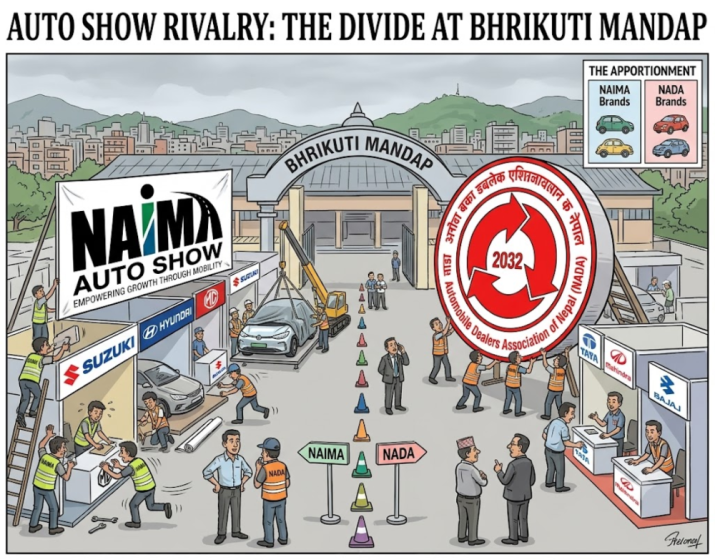
For decades, the annual auto show calendar in Nepal revolved around one dominant event. That certainty is gone.
The country’s automotive sector is now heading into an unusually fragmented exhibition season as the newly formed Nepal Automobile Importers Association (NAIMA) prepares to launch its first Nepal Mobility Expo on August 5, while the long-established NADA Auto Show is scheduled to open on August 19. Both events will take place at Bhrikuti Mandap in Kathmandu, separated by only two weeks.
That timing is not a coincidence. It is the public expression of a deeper industry divide that has been building for years.
Former NADA presidents, including Saurabh Jyoti and Shekhar Golchha, played a role in establishing NAIMA after longstanding disagreements within the association intensified. What had once been internal politics has now evolved into competing organizations, competing events and competing visions for the future of Nepal's automotive sector.
And that's important.
The split has forced brands and distributors to choose sides, at least for now.
Several established importers remain aligned with NADA, including companies representing Tata Motors, Suzuki, Xpeng, Hero, Riddara, Yamaha, Deepal and Dongfeng.
NAIMA, meanwhile, has assembled a broad portfolio that includes distributors representing:
According to NAIMA, its Mobility Expo has attracted 50 participating automobile brands and 48 exhibition stalls across four-wheelers, two-wheelers and commercial vehicles.
| Event | Venue | Schedule |
|---|---|---|
| NAIMA Nepal Mobility Expo | Bhrikuti Mandap | August 5-9, 2026 |
| NADA Auto Show | Bhrikuti Mandap | August 19-24, 2026 |
Auto shows are expensive exercises.
Brands invest heavily in exhibition structures, product displays, staffing, logistics and marketing campaigns. Running two major exhibitions within a two-week window creates a challenge few dealers expected at the start of the year.
Some industry participants fear the situation could dilute visitor interest rather than expand it. Meroauto reports that dealers have drawn comparisons with trade fairs in other sectors that initially generated strong traffic before losing momentum as the market became saturated with too many events.
Here's the thing.
Visitors may enjoy having more choice, but exhibitors need measurable returns. If consumer attention becomes fragmented, both events risk falling short of expectations.
The concern is not theoretical. Global auto shows have faced attendance and participation challenges in recent years as manufacturers increasingly rely on digital launches and targeted marketing events. Several international exhibitions have also seen brands selectively skip events depending on strategic priorities.
The emerging lineup offers an interesting snapshot of Nepal's automotive market.
Many of the brands aligned with NAIMA are among the country's strongest passenger vehicle and electric vehicle players. At the same time, NADA retains support from significant distributors and several high-profile EV brands.
This is no longer simply a disagreement between associations.
It has become a contest for relevance, influence and long-term industry leadership.
| Association | Notable Brands Mentioned | Position |
|---|---|---|
| NADA | Tata, Suzuki, Xpeng, Hero, Yamaha, Deepal, Dongfeng | Established exhibition platform |
| NAIMA | Toyota, Hyundai, Kia, Volkswagen, BYD, MG, Nissan, Mahindra | New challenger organization |
The immediate battle is about attendance, bookings and brand visibility.
The longer-term question is more significant.
Can Nepal's automobile industry support two major exhibitions every year, or will market forces eventually push the sector back toward a unified platform?
No clear answer exists yet.
What is certain is that 2025 will serve as a real-world test. Visitor numbers, vehicle bookings and exhibitor satisfaction will be watched closely across both events.
Not everyone will notice it immediately. But the success or failure of these shows could determine how Nepal's automotive industry organizes itself for the next decade.
That matters.
NAIMA has already completed stall allocation for its debut Mobility Expo, while NADA has continued preparations for its long-running exhibition platform. Both organizations are positioning their events as key destinations for new vehicle launches, technology showcases and consumer engagement.
As August approaches, dealers, manufacturers and buyers will effectively become judges.
Their participation will reveal whether Nepal's market is large enough to sustain two competing automotive showcases, or whether the industry eventually finds its way back to a single stage.
Q: When is the NAIMA Nepal Mobility Expo 2025 being held?
A: The NAIMA Nepal Mobility Expo is scheduled for August 5 to 9, 2026, at Bhrikuti Mandap in Kathmandu. The event marks NAIMA's first major automotive exhibition.
Q: When does the NADA Auto Show 2025 begin?
A: The 17th NADA Auto Show is scheduled from August 19 to 24, 2026, also at Bhrikuti Mandap. It will take place roughly two weeks after the NAIMA event.
Q: Why are there two separate auto shows in Nepal?
A: The situation emerged after divisions within the automotive industry led to the creation of NAIMA. The new association decided to organize its own exhibition alongside the established NADA Auto Show.
Q: Which major brands are participating in NAIMA?
A: Participating brands include Toyota, Hyundai, Kia, Volkswagen, BYD, MG, Nissan, Mahindra, Omoda and Jaecoo, among others.
Q: Which brands remain aligned with NADA?
A: Brands associated with NADA include Tata, Suzuki, Xpeng, Hero, Yamaha, Deepal, Dongfeng and Riddara, according to industry participation reports.
Q: Why are dealers concerned about the dual-show format?
A: Dealers worry that two large exhibitions in quick succession could increase costs, divide visitor traffic and reduce overall commercial returns for exhibitors.

Nepal Auto-Trader is one-stop platform for all automotive needs. We provide unbiased and unparalleled news/reviews of all auto-motives being launched in Nepalese Auto-Industry. Find recent updates and price of bikes/cars, compare and review recently launched bikes/cars, buy/sell/trade reconditioned cars/bikes and all government news about changing rules and regulation, road safety by subscribing us.

Subscribe to our Newsletter
© Copyright 2026, Nepal Autotrader


.png)
.png)