

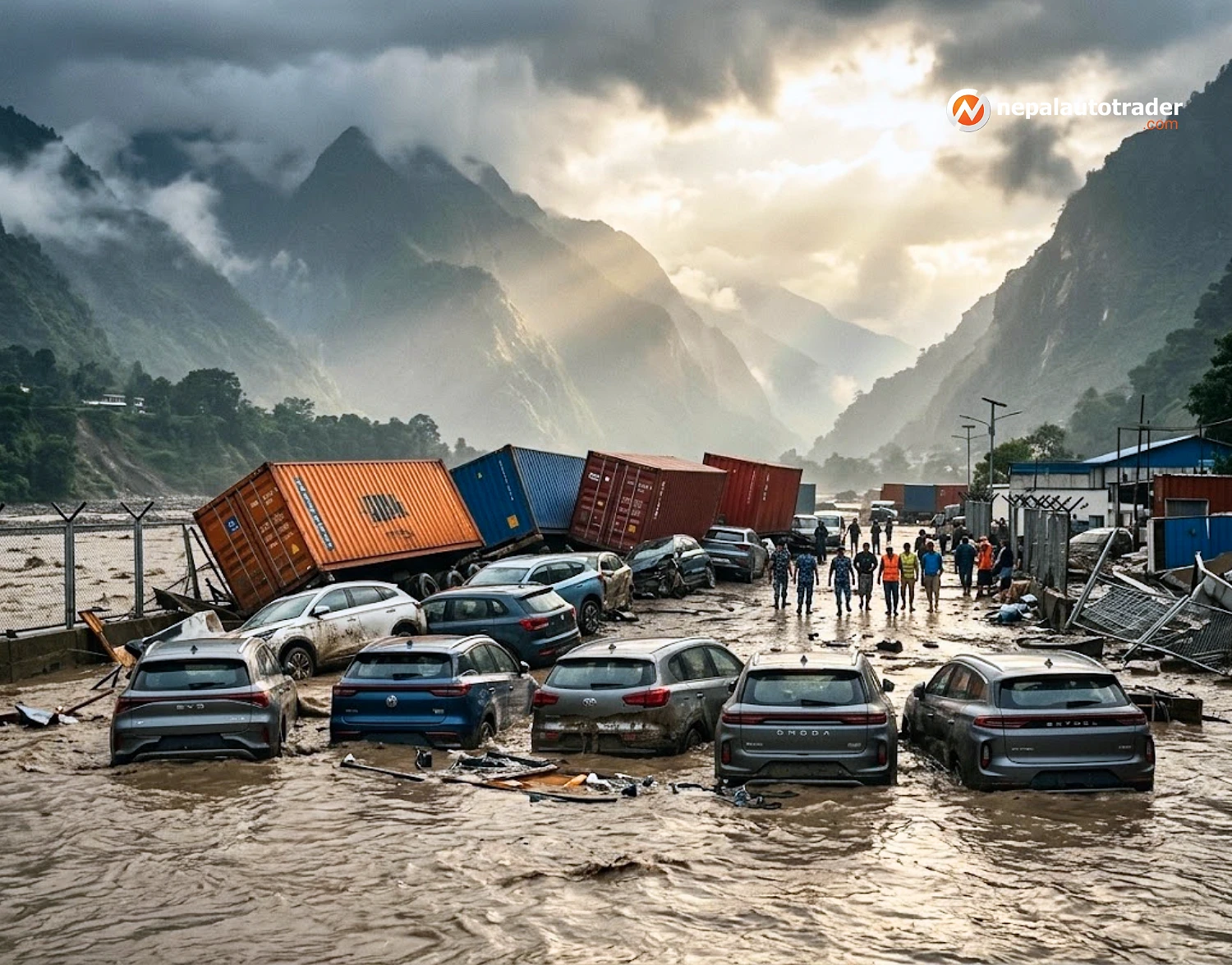
The damage is difficult to separate from the timing. Nepal's automobile industry was preparing for one of its busiest selling periods when a sudden flood from Tibet struck the Rasuwagadhi area on Wednesday morning.
The resulting surge in the Bhotekoshi River swept through the Rasuwagadhi customs area and nearby locations, taking vehicles and freight with it. More than 800 electric vehicles and containers were swept away, while the exact official count was still unavailable at the time of reporting.
For an industry that depends heavily on cross border movement, the incident is more than a loss of inventory. Cars that were already positioned for the Nepalese market have disappeared before reaching customers, while goods moving through the same corridor have also been affected.
That creates a second problem after the physical damage. Supply has to be rebuilt.
Automobile businesses estimate that more than 700 electric cars were swept away. Some had already cleared customs, while others were positioned in the Rasuwagadhi customs yard or along nearby roads as dealers prepared them for the market.
| Reported impact | Details |
|---|---|
| Electric cars | More than 700 reportedly swept away |
| BYD vehicles | More than 200 reportedly swept away |
| Other EV brands | About 500 vehicles from several brands reportedly affected |
| Containers | More than 100 initially reported swept away |
The brand mix underlines how broad the impact could be. More than 200 BYD vehicles were reportedly lost, while roughly 500 vehicles from MG, Wuling, Omoda, Jaecoo, iCar, BAIC, Arcfox, Foton and Skywell were also reported among the affected stock.
These are not production numbers or confirmed insurance totals. They are estimates from automobile businesses while authorities work toward a formal assessment. That distinction matters, particularly when the reported losses are measured in billions of rupees.
Dealers had been importing large numbers of vehicles ahead of the festive season, with demand also tied to bookings generated around the recent NADA Mobility Expo and the ongoing NADA Auto Show 2026. The flood therefore hit inventory that had a clear commercial purpose, rather than sitting idle in storage.
That timing could make the disruption visible to buyers fairly quickly. Customers who have already booked vehicles may now face longer waits, while dealers need to source replacement units through another route.
The wider market was already moving quickly. Recent reporting described strong competition among EVs priced between 30 lakh and 40 lakh, with customers increasingly comparing battery capacity, claimed range, motor power, ground clearance, cabin space, features and after sales support.
In that environment, supply matters almost as much as the product itself. A compelling vehicle is of little use to a customer if the dealer cannot deliver it.
Cars are only part of the story. The same flood swept away freight containers carrying goods from China, adding another layer of disruption to the trade route.
Ramhari Karki, president of the Nepal Himalaya Trans Himalayan Commerce Association, told that more than 200 containers in the Rasuwagadhi customs yard were affected. He estimated that the yard had between 200 and 250 containers carrying goods, while more than 60 containers that had already cleared customs were also reported swept away. Empty containers and others involved in loading operations were affected as well.
| Freight category | Reported situation |
|---|---|
| Containers in customs yard | Estimated 200 to 250 carrying goods |
| Cleared containers | More than 60 reportedly swept away |
| Other containers | Empty containers and containers involved in loading also affected |
The figures are still estimates, and the final count could change. But the direction is clear. The flood has disrupted a transport corridor that connects Chinese goods with the Nepalese market, and the consequences are not limited to vehicle dealers.
For consumers, the most immediate concern is availability rather than technology. A customer who has already booked an affected vehicle may have to wait while the dealer arranges replacement stock.
It is too early to say whether the incident will change retail prices. The source does not provide evidence of price increases, and it would be premature to predict them. What is clear is that dealers now have a supply problem to solve.
The scale of the disruption also puts the importance of logistics into sharp focus. Nepal's EV market has expanded rapidly, but imported vehicles still depend on physical corridors that can be vulnerable to extreme weather.
The next phase will be less dramatic than the flood itself, but potentially more important for the automobile industry. Dealers must assess what was lost, determine which bookings are affected and begin arranging replacement vehicles.
That process will take place against an already competitive EV market. The NADA Auto Show 2026 has brought brands together at a time when buyers have more choice and are paying closer attention to specifications and ownership support. The latest flood adds a factor that is rarely visible on a showroom floor, logistics reliability.
There is also a broader infrastructure question. If major vehicle volumes and commercial freight can be disrupted so quickly along a key border corridor, importers and policymakers will have to consider how resilient those routes are during severe weather.
The significance emerges when viewed in a broader context. Nepal's EV transition is not simply about batteries, charging stations and new models. It also depends on roads, customs yards, bridges, freight networks and the ability to keep vehicles moving from the border to the customer.
For now, the industry is left counting losses. The final numbers are still to come, but the disruption has already exposed how quickly a natural disaster can reach the heart of Nepal's automotive supply chain.
Q: How many EVs were swept away by the flood?
A: More than 700 electric cars were swept away, while automobile businesses estimated more than 800 EVs and containers were affected in total. Official figures were not available at the time of reporting.
Q: Which EV brands were affected by the Rasuwagadhi flood?
A: The reported brands include BYD, MG, Wuling, Omoda, Jaecoo, iCar, BAIC, Arcfox, Foton and Skywell. More than 200 BYD vehicles were reportedly among the affected cars.
Q: Where did the flood damage occur?
A: The flood affected the Rasuwagadhi customs area and surrounding locations after a sudden surge in the Bhotekoshi River, with the flood coming from Tibet on Wednesday morning.
Q: Were containers also swept away?
A: Yes. More than 100 containers were initially reported swept away. A separate estimate from the Nepal Himalaya Trans Himalayan Commerce Association put the number of containers carrying goods in the customs yard at 200 to 250, with more than 60 cleared containers also reportedly lost.
Q: Will EV prices increase because of the flood?
A: The source does not report any confirmed price increase. The immediate concern is supply, with dealers potentially facing delays in replacing vehicles lost in the flood.
Q: Could EV deliveries be delayed?
A: Yes. Dealers may be unable to deliver some booked vehicles on time and may need to bring replacement vehicles through another route. The exact effect will depend on each brand's affected inventory and replacement supply.

Nepal Auto-Trader is one-stop platform for all automotive needs. We provide unbiased and unparalleled news/reviews of all auto-motives being launched in Nepalese Auto-Industry. Find recent updates and price of bikes/cars, compare and review recently launched bikes/cars, buy/sell/trade reconditioned cars/bikes and all government news about changing rules and regulation, road safety by subscribing us.

Subscribe to our Newsletter
© Copyright 2026, Nepal Autotrader


.png)
.png)