

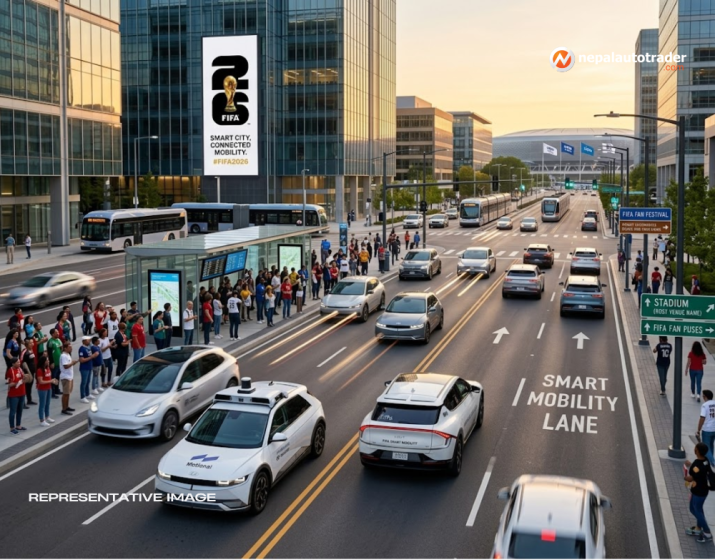
The countdown to FIFA World Cup 2026 is no longer just about football. Behind the scenes, the automotive industry is preparing for what could become one of the largest real-world demonstrations of smart mobility ever attempted.
With matches spread across the United States, Canada and Mexico, the logistical challenge is immense. Millions of fans, thousands of officials, media personnel and tournament staff will need to move efficiently between airports, stadiums, hotels and fan zones.
That matters.
For automakers, the tournament represents something far bigger than brand exposure. It offers a rare opportunity to prove how connected vehicles, intelligent fleet management and emerging robotics technologies perform under pressure.
Recent developments from Hyundai and Kia show just how seriously manufacturers are treating the event. FIFA World Cup 2026 is rapidly becoming a showcase for the future of transportation.
Hyundai Motor, a long-time FIFA partner, has announced its biggest tournament deployment ever.
The company will provide a fleet consisting of 994 passenger vehicles and 506 buses, supporting transportation requirements across all 16 host cities. The vehicles will be used by national teams, officials, media organizations and operational staff.
| Deployment Category | Quantity | Purpose |
|---|---|---|
| Passenger Vehicles | 994 | Teams, officials and media transport |
| Buses | 506 | Tournament operations and logistics |
| Robotics Units | 4 Spot robots | Venue monitoring and patrol support |
The vehicle lineup includes several familiar Hyundai models:
Hybrid variants will also be available on selected models, reflecting the industry's growing focus on lower-emission mobility solutions.
Not everyone will notice it immediately. Yet moving thousands of accredited personnel every day without disruption may be just as important as what happens on the pitch.
Here's the thing.
The most interesting story may not involve vehicles at all.
For the first time, Hyundai will introduce official robotics deployment at a FIFA tournament. Four customized Boston Dynamics Spot robots will support autonomous patrol and monitoring functions at selected World Cup venues.
This marks a significant shift in how major sporting events are managed.
Instead of relying solely on traditional security and operational monitoring systems, organizers are increasingly exploring autonomous technologies capable of collecting data, monitoring activity and supporting large-scale venue management.
While the deployment remains limited in scale, the symbolism is difficult to ignore. The future mobility conversation is expanding beyond transportation and into intelligent infrastructure.
And that's important.
Kia is also playing a substantial role in tournament operations.
The brand has confirmed deployment of 660 vehicles across the United States, Canada and Mexico as part of its FIFA mobility partnership.
| Brand | Fleet Size | Key Models |
|---|---|---|
| Hyundai | 1,500 vehicles and buses | PALISADE, TUCSON, KONA, SONATA, GENESIS GV80 |
| Kia | 660 vehicles | Telluride, Sportage, Carnival, Sorento, Niro, K4 |
Kia's operational fleet includes:
The company says the deployment is designed to support innovative and sustainable transportation throughout the tournament period.
For both Hyundai and Kia, the World Cup offers a highly visible proving ground. Reliability, efficiency and user experience will be tested daily under global scrutiny.
Hosting the largest FIFA World Cup in history creates transportation challenges that traditional systems often struggle to manage.
Host cities are increasingly looking at integrated mobility strategies that combine:
Toronto's published mobility planning, for example, highlights a strong focus on public transit, active transportation and coordinated traffic management during tournament operations.
The broader trend is clear. Major global events are becoming testing grounds for smarter urban mobility systems.
The automotive industry's investment in FIFA World Cup 2026 extends beyond a few weeks of tournament activity.
Manufacturers are using the event to gather operational data, showcase technology and demonstrate how intelligent transportation systems perform at scale.
Some innovations will fade into the background once the tournament ends. Others may influence how future cities manage mobility, congestion and event logistics.
That's the larger story unfolding here.
The World Cup may crown a football champion next summer, but it is also becoming a proving ground for the next generation of transportation. And for automakers eager to shape that future, the tournament could be just the beginning.
Q: How many vehicles will Hyundai deploy for FIFA World Cup 2026?
A: Hyundai will deploy 994 passenger vehicles and 506 buses, creating a total tournament fleet of 1,500 vehicles and buses supporting operations across 16 host cities.
Q: What robots will be used during FIFA World Cup 2026?
A: Hyundai plans to deploy four customized Boston Dynamics Spot robots to assist with autonomous patrol and monitoring functions at selected tournament venues.
Q: How many vehicles is Kia supplying for the tournament?
A: Kia has confirmed a fleet of 660 vehicles that will support transportation and operational requirements across the United States, Canada and Mexico.
Q: When will FIFA World Cup 2026 take place?
A: The tournament is scheduled to run from June 11 to July 19, 2026, across host cities in three countries.
Q: Why are automakers investing heavily in World Cup mobility programs?
A: The event provides a global platform to showcase smart mobility technologies, fleet management systems, sustainable transportation solutions and emerging robotics capabilities.
Q: Will smart mobility technologies continue after the tournament?
A: Many of the operational lessons and technologies tested during FIFA World Cup 2026 could influence future urban mobility planning and large-scale event transportation strategies.

Nepal Auto-Trader is one-stop platform for all automotive needs. We provide unbiased and unparalleled news/reviews of all auto-motives being launched in Nepalese Auto-Industry. Find recent updates and price of bikes/cars, compare and review recently launched bikes/cars, buy/sell/trade reconditioned cars/bikes and all government news about changing rules and regulation, road safety by subscribing us.

Subscribe to our Newsletter
© Copyright 2026, Nepal Autotrader


.png)
.png)